
USCIS approved this project. Here is the notice.
Mid-America Rural Development Inc., the regional center, filed Form I-956F for this project on December 27, 2023. USCIS approved it on September 3, 2024. The receipt number, the regional center’s USCIS listing and the approval notice itself are all below, so you can confirm this without asking us for anything.
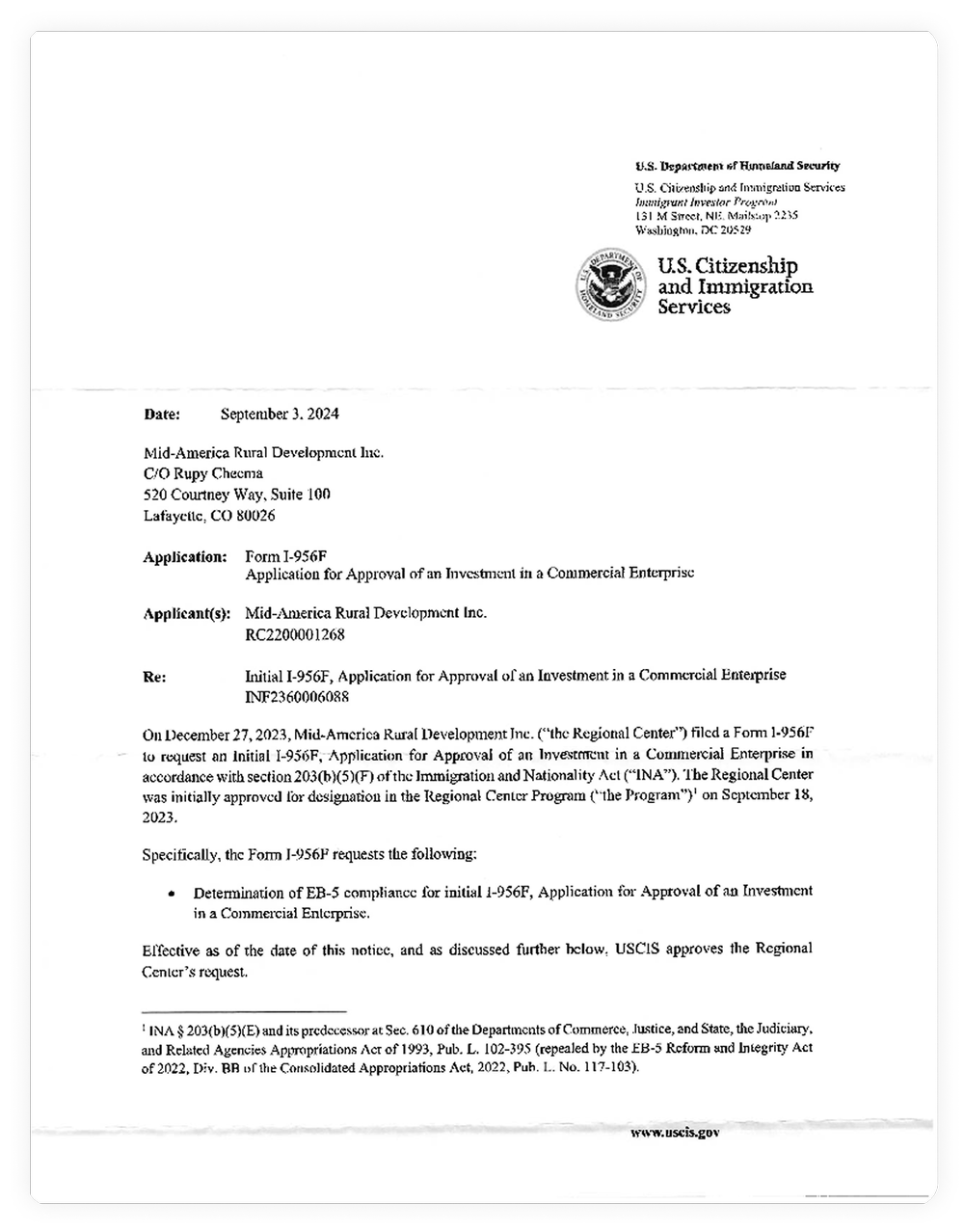
Form I-956F approval notice, September 3, 2024. Read the full notice (PDF)
What the approval covers — and what it doesn’t
This is the distinction that matters most, and the one most easily blurred. USCIS reviewed the project. It has not reviewed you.
USCIS reviewed and approved
- The business plan for the project
- The investment structure
- The job-creation methodology and economic analysis
- The project’s rural TEA designation
- Compliance with the EB-5 Reform and Integrity Act of 2022
The approval does not address
- Your individual eligibility as an investor
- The lawful source of your funds
- Whether your I-526E petition will be approved
- Whether the investment will perform, or your capital be returned
- Any endorsement of this offering by the U.S. government
Confirm it independently
Everything in this section can be checked against a government source or a third party.
- The approval notice
- Form I-956F, receipt INF2360006088, approved September 3, 2024. Read the full notice (PDF).
- Regional center listing
- Mid-America Rural Development Inc. (RC2200001268) was designated on September 18, 2023 and appears on USCIS’s published list of approved regional centers.
- Where the money is held
- Customers Bank acts as escrow agent and releases funds upon USCIS receipt notice — when your petition is receipted, before it is adjudicated.
- Who oversees disbursement
- Trident Trust reviews and co-approves disbursements as fund administrator. Mid-America Rural Development oversees compliance and reporting.
- What governs the offering
- The private placement memorandum, limited partnership agreement and subscription agreement. They control over anything on this page. Request the documents.
Investor petitions
Both approval notices are reproduced below, redacted.
Petition outcomes to date do not guarantee the outcome of any future petition. Each I-526E is adjudicated on its own facts, including the investor’s eligibility and the lawful source of their funds.
Approved under both classifications
Each notice approves the petition under INA § 203(b)(5) in two categories at once. This is USCIS confirming the rural set-aside on real investor petitions, not just on the project filing.
- RU-1 — unreserved
- Principal Regional Center Investor. The general EB-5 category.
- RR-1 — reserved
- Rural Principal Regional Center Investor. Draws on the 20% of annual EB-5 visas set aside for rural projects.
- Petition one
- Priority date February 13, 2024. Approved July 7, 2025. Read the notice (PDF, redacted).
- Petition two
- Priority date February 16, 2024. Approved August 1, 2025. Read the notice (PDF, redacted).
- Filed by independent counsel
- The two approved petitions were prepared and filed by two different immigration law firms, each engaged by the investor rather than by us.
- What is Form I-526E?
- The individual investor petition, filed with USCIS by you rather than by the project. Approval confirms your eligibility and the lawful source of your funds, and is required before a visa can be issued. The project’s I-956F approval does not substitute for it.
How long adjudication actually took
We would rather you got this from us than worked it out from the dates on the notices.
What our first investors experienced
Both petitions were filed in February 2024 — about seven months before this project itself was approved. USCIS could not decide them until the project’s I-956F approval issued on September 3, 2024.
Measured from that point, the two approvals came roughly ten and eleven months later, in July and August 2025. Measured from the filing dates on the notices, about seventeen months — but that figure includes the wait for the project approval, which no petition could be decided ahead of.
These were also early filings in a sector uncommon in EB-5, adjudicated with little precedent to draw on.
Where timelines stand now
USCIS adjudicates petitions on its own schedule. Once a project has been approved, petitions filed against it are adjudicated in the ordinary course — project approval does not place one project’s investors ahead of another’s, and no sponsor has any influence over how quickly a petition is reviewed.
Our understanding is that rural petitions are currently being decided anywhere from a few months to around twelve months. That is an observation about the program as a whole, not a statement about this project, and not something we can promise or affect.
Check the figure USCIS publishes rather than relying on any number on a sponsor’s website, including this one.
Why rural changes the timing
Two consequences follow from the project’s rural TEA designation, and both affect how long you wait rather than whether you qualify.
Priority processing
USCIS gives petitions tied to rural projects priority in the adjudication queue — they are taken up ahead of non-rural petitions. See below for what this meant for our first two investors, and where timelines stand across the program now.
The rural visa set-aside
20% of annual EB-5 visas are reserved for rural projects — double the 10% set aside for high-unemployment urban projects. For investors from countries where the general EB-5 queue is backlogged — currently India and China — this is the practical difference between a wait measured in years and one measured in months.
Three dates worth knowing
These are set by statute and apply to the EB-5 program generally, not to this project specifically.
Petitions filed on or before this date remain eligible for adjudication even if the Regional Center Program is not reauthorized afterwards. This is the grandfathering provision, and it is the date that governs timing for most investors.
The minimum investment amount is scheduled for its first inflation adjustment under the 2022 Act. The size of that adjustment has not been set. Investors who subscribe before this date do so at the current $800,000 minimum.
The Regional Center Program is authorized through this date. Whether Congress reauthorizes it afterwards is not something any sponsor can predict, which is what makes the 2026 grandfathering date matter.
Questions about the approval?
The 21-minute investor briefing opens with the immigration structure — what the I-956F covers, the three tests, and how jobs are counted. Or ask us directly.
Watch the briefing Schedule a callFor educational purposes only. This is not an offer to sell or a solicitation of an offer to buy any security. EB-5 investments involve risk, including possible loss of principal, and participation does not guarantee a visa or permanent residency. Offers are made only through official offering documents to qualified investors. I-956F project approval does not guarantee approval of any individual investor petition. Immigration timelines are estimates based on current USCIS processing data and are subject to change. Consult your own immigration, securities and tax advisors before making an investment decision.