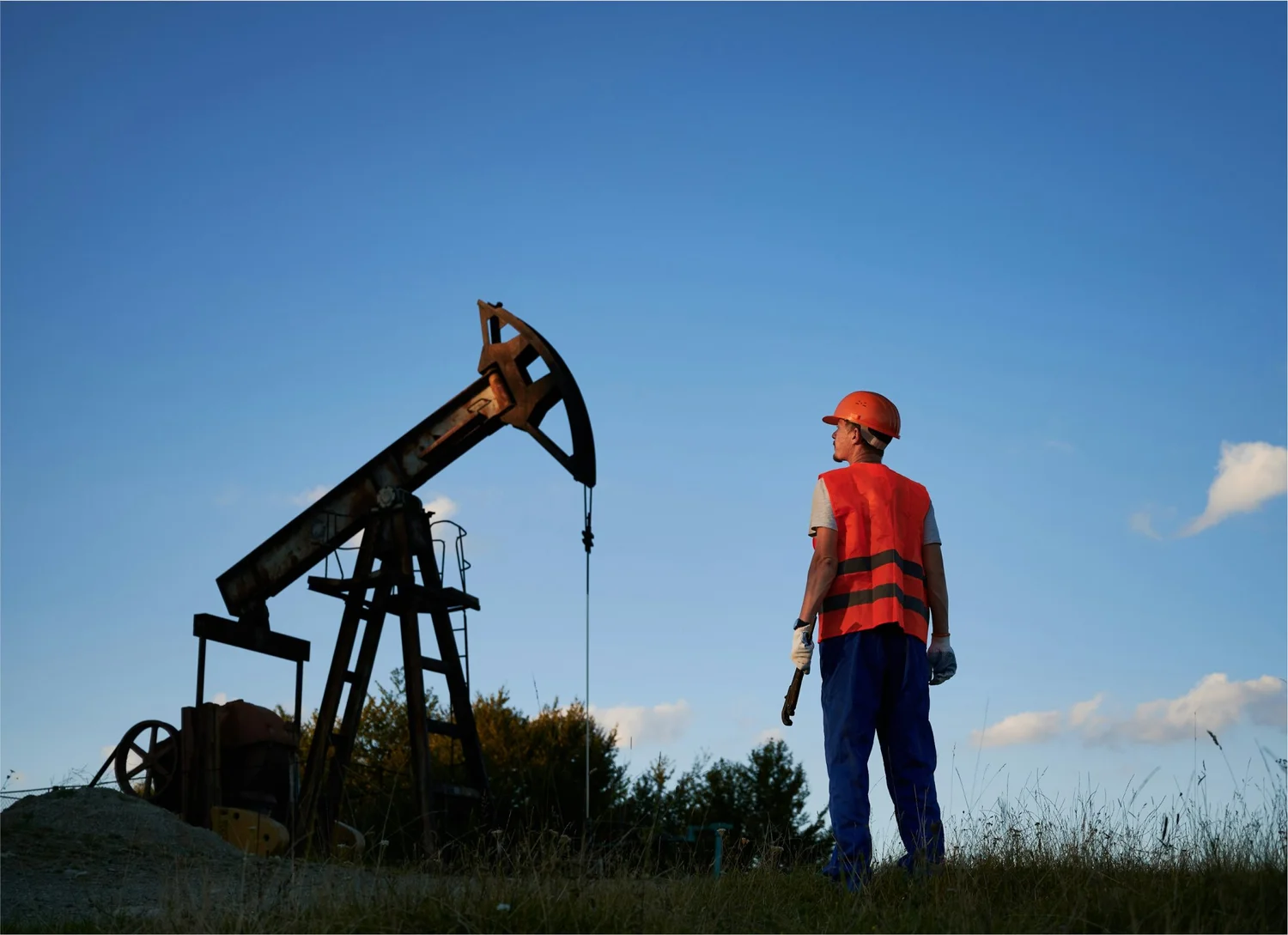
Major County, Oklahoma · Anadarko Basin
Eight Wells on Ground That Has Already Produced.
EB5 Energy holds 1,280 acres in Major County, Oklahoma, and has mineral rights secured for its first eight horizontal wells. Every well site sits within a mile of an existing gas pipeline connection.
The formation these wells target has been drilled on this acreage before. That is the difference between a projection and a record, and it is what this page is about.
What the capital buys
One Well, Four to Four and a Half Million Dollars.
A horizontal well in this program costs approximately $4 million to $4.5 million to drill and complete — roughly five to six investors’ worth of EB-5 capital for a single well.
EB-5 subscriptions are not the only source of funds. Private investor capital funds the balance of the eight-well program, so drilling does not wait on the EB-5 raise filling.
Mineral rights are secured for the first eight wells. Wells beyond those are within the approved scope but are not yet funded or under contract.
The location
The Anadarko Basin, and the Mississippi Lime.
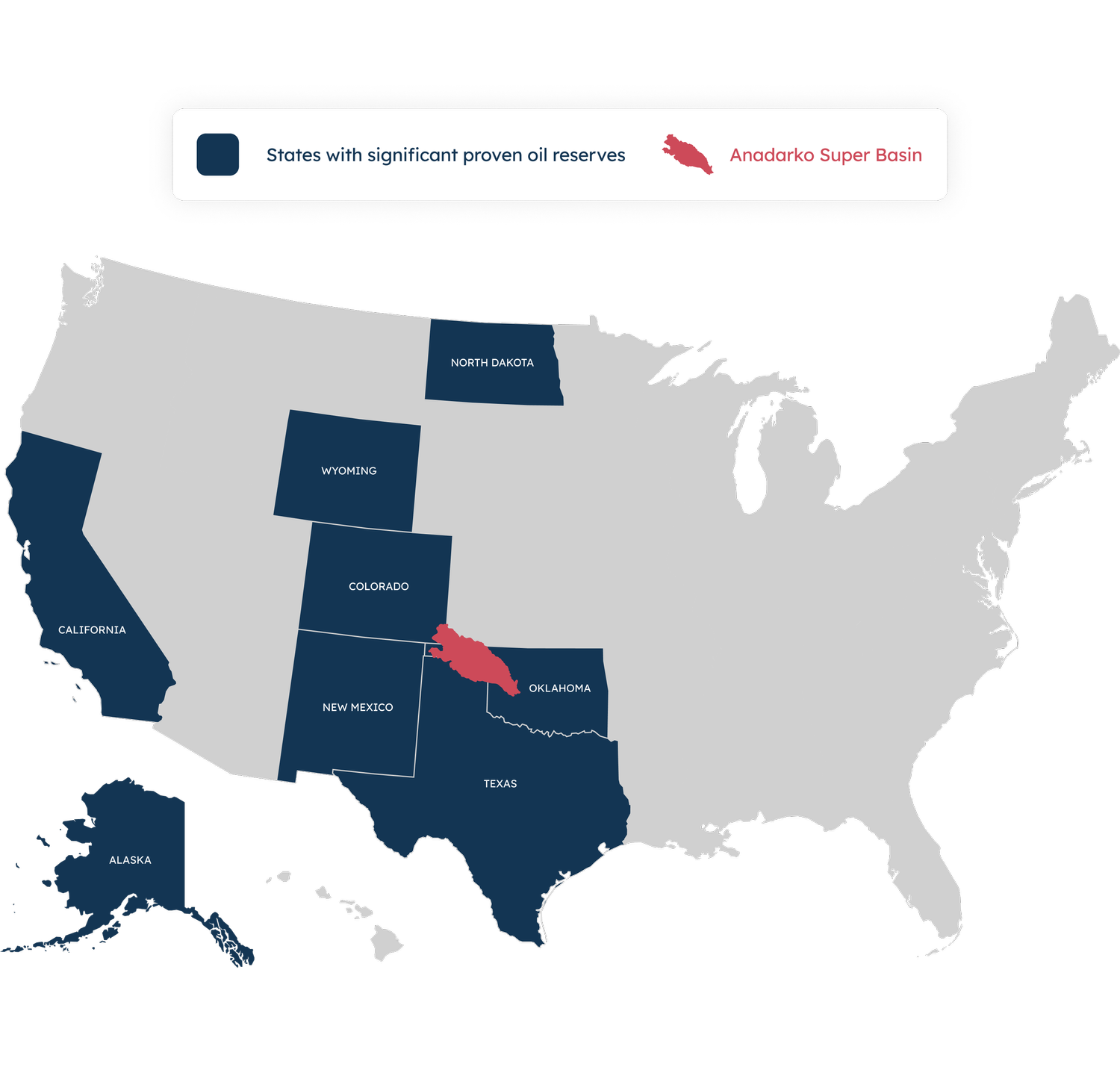
The Anadarko Basin spans more than 50,000 square miles across Oklahoma and Texas. Published estimates credit the basin with 1.8 billion barrels of oil and 11.7 trillion cubic feet of natural gas in proved reserves — a basin-wide figure, not a statement about our acreage — and it has supported continuous commercial production for over a century.
EB5 Energy’s wells target the Mississippi Lime — an established producing horizon with extensive drilling history across Major County. The surrounding area holds hundreds of active producing wells.
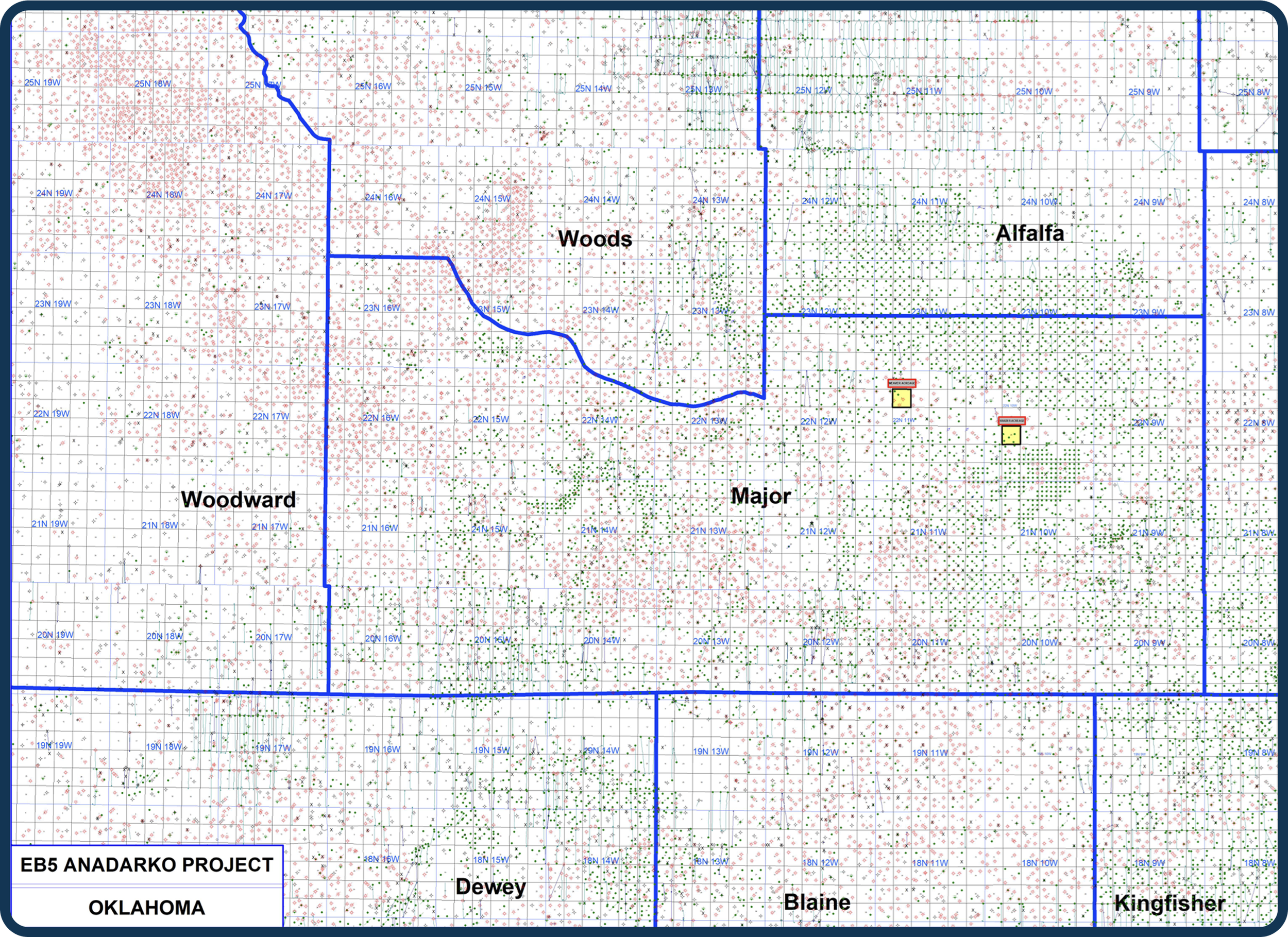 Weaver Acreage
Nader Acreage
Weaver Acreage
Nader Acreage
- Within one mile of a pipeline connection. Lower transportation cost and a shorter path to market than trucking production out.
- A formation with a production record. The Mississippi Lime has been drilled across Major County for decades.
- Infrastructure already in place. Existing roads, utilities and midstream facilities reduce what has to be built before a well can produce.
- A stable operating state. Oklahoma is among the country’s largest oil and gas producers, with settled regulation and established permitting.
Two sources of production evidence
This Isn’t Unexplored Ground.
We do not have to rely on geological projection alone. This is productive acreage with a sixty-year record: we can look at what has already been produced from it, and at what modern horizontal wells nearby have actually produced.
Sixty Years On, This Acreage Is Still Producing
Eleven vertical wells were drilled on our two sections between 1963 and 1989. Six reached the Mississippi Lime formation that our horizontal wells will target. All six produced from it — and five of those six are still producing today, decades after they were drilled.
- Of the six wells into the Mississippi Lime, still producing today
- 5 of 6
- Oil produced from those six wells
- 68,700 bbl
- Natural gas produced
- 4+ Bcf
The other five historical wells were drilled to shallower targets and never tested the Mississippi Lime.
That is what makes this productive acreage rather than a prospect. A well that has produced for decades and has not stopped is a longer record than most drilling programs can point to anywhere, let alone on the ground they are about to drill.
It settles one question and not the other. It shows the oil is there and that the formation keeps giving it up. It does not show how much can be recovered, because the vertical technology of the period could not reach most of what the rock holds.
Modern Horizontal Wells Answer the Other Half
Ten horizontal wells drilled between 2017 and 2024, approximately three to seven miles from our acreage, target the same Mississippi Lime at similar depths, using the same basic horizontal methodology and the approximately one-mile laterals EB5 Energy plans to use.
Swipe the chart sideways to see all of it.
The comparable wells ranged from approximately 293 to 812 barrels per day at peak, and have averaged approximately 170,000 barrels of oil per well to date. EB5 Energy’s projection of 300 barrels per day sits at the bottom of that observed range rather than at its middle.
Don’t Take Our Word for It.
The historical and comparable-well production figures come from production information operators are required to report to the State of Oklahoma. Any investor or adviser can verify them independently, against records that are not ours.
Historical and nearby production do not guarantee the performance of EB5 Energy wells. They are evidence that helps evaluate the opportunity, not a forecast of what these wells will do.
From permit to production
Drilling, Completion, and Getting to Sales.
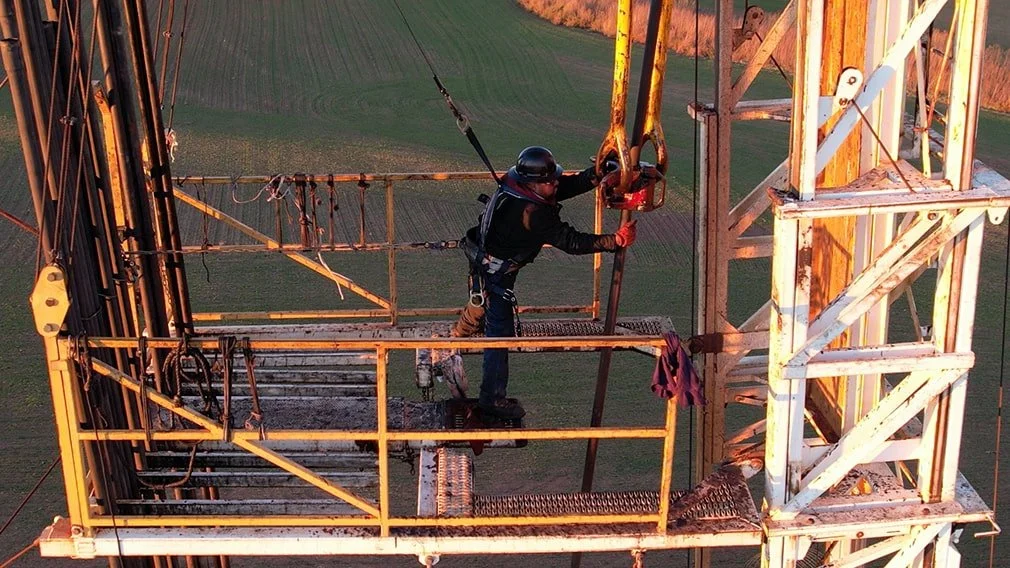
The wells are drilled horizontally into the Mississippi Lime and completed by hydraulic fracturing along the lateral — the technique the vertical wells of the 1960s to 1980s did not have, and the reason the same rock can now yield what it could not then.
Proximity to existing pipeline connections shortens the step that often delays revenue on a new well: getting production from the wellhead to a buyer.
The requirement the investment has to meet
A 49% Job Surplus, and How It Gets Created.
Every EB-5 investor must be credited with ten qualifying jobs. In a regional center project those jobs are estimated by an independent economic study, and the petition depends on the project creating them.
They are not headcount on a payroll. The model counts jobs generated by two things the project does anyway: money spent drilling and completing wells, and revenue collected from selling what those wells produce. Both flow through the local economy, and both create jobs in the model — which is why job creation here tracks activity rather than depending on one employer’s hiring.
The eight wells now being funded project 309 qualifying jobs on the same basis. The surplus above grows as more of the 72 are drilled, because both halves of the model — what is spent and what is earned — grow with the number of producing wells.
Job creation is estimated by an independent economic study and is a projection, not a guarantee. The 49% figure is the margin across the full 72-well program, if all 72 are drilled, against the 1,500 jobs that 150 investors require. At any smaller number of wells the margin depends on how many investors are admitted against that program. The revenue half of the model is computed at $72 a barrel — the assumption filed with USCIS, not a forecast of any future price.